SustainabilityInformation Disclosure Based on TCFD Recommendations

NIPRO Group recognizes climate change as a critical issue that significantly impacts business continuity. NIPRO Group endorses the recommendations of the Task Force on Climate-related Financial Disclosures (TCFD) and will enhance its disclosures in accordance with the TCFD framework.
Governance
At NIPRO Group, the President and Representative Director serves as the Chief Climate Change Officer. Furthermore, by appointment of the President and Representative Director, our CFO serves as Chair of the Environmental Committee, managing and overseeing NIPRO Group's efforts to address climate change issues.
Environmental Committee, composed of climate change officers from each business division, identifies the impacts of climate change on NIPRO Group, establishes policy directions, and examines specific measures. Measures reviewed by the committee are submitted to the Board of Directors via the committee chair and are deliberated as key management issues for NIPRO Group.
NIPRO Group has established a committee system as described above to enable swift management decision-making on climate change issues and to build a framework for implementing countermeasures.
Strategy
The impacts of climate change on NIPRO Group can be broadly categorized into two types: those related to “transition” arising from political influences, the establishment of new technologies, and shifts in market needs as society evolves toward carbon neutrality; and those related to “physical changes” such as the increased frequency of extreme weather events, associated disasters, and rising average temperatures caused by advancing global warming.
NIPRO Group, a comprehensive medical manufacturer, analyzes these impacts from the perspective of each business division, identifies specific risks and opportunities, and incorporates them into its business strategy. The table below shows an excerpt of one such example.
Risk management
NIPRO Group has established the “Disaster Prevention and Crisis Management Regulations” and the “Compliance Promotion Regulations.” We strive to accurately identify management risks that could significantly impact our business, including climate-related risks, and to ensure appropriate corporate management.
Furthermore, whenever anticipated risks exceed a certain threshold, they are promptly brought before the Board of Directors for swift management decision-making on risk control.
Indicators and Targets
NIPRO Group has established greenhouse gas emissions (unit:t-CO2) as an indicator for assessing and managing risks related to climate change.
Furthermore, to promote the reduction of greenhouse gas emissions, we aim to achieve Net Zero Scope1/2 emissions by 2045. As an interim target, we aim to reduce Scope1/2 emissions by 37.8% compared to 2021 levels by 2030.
Greenhouse gas emissions(unit:t-CO2)
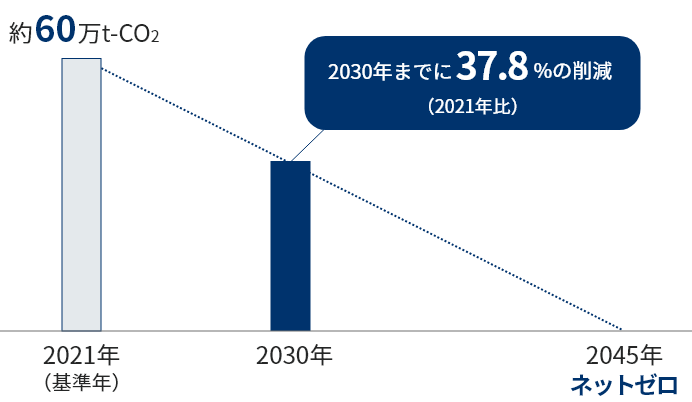
Greenhouse gas emissions
| Item | 2022 | 2023 | 2024 |
|---|---|---|---|
| Scope1 | 185,539 | 169,999 | 174,441 |
| Scope2(Location-based) | 368,995 | 392,255 | 419,355 |
| Scope2(Market-based)* | 377,106 | 400,204 | 413,547 |
| Scope1+Scope2(Market-based) | 562,645 | 570,203 | 587,988 |
| Offset through Renewable Energy Certificates | 30,380 | 65,700 | 200,529 |
| After offset Scope1+Scope2(Market-based) | 532,265 | 504,503 | 387,459 |
* Scope2(Market-based): Emissions calculated using the market-based approach for NIPRO CORPORATION and its Japanese subsidiaries only, combined with emissions calculated using the location-based approach for overseas subsidiaries.
Third-party verification
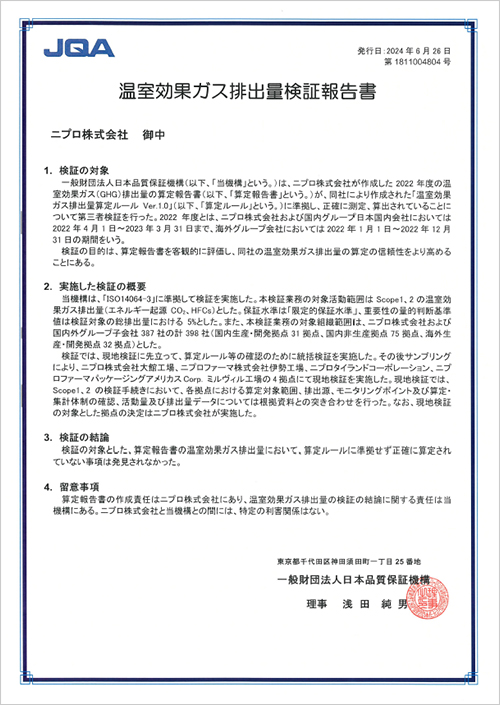
NIPRO Group has undergone third-party verification by the Japan Quality Assurance Organization since fiscal year 2022 to enhance the reliability of its environmental performance data for greenhouse gas emissions (Scope 1, Scope 2).
We will continue to utilize third-party verification more effectively, drive continuous improvement, and enhance the reliability of our data.
Results of the scenario analysis
Risk
| Classification | Risk Item | Impact on Business | Severity | Timing | Countermeasures |
|---|---|---|---|---|---|
| Transition Risk (1.5°C Scenario) | Rising carbon prices | The introduction and strengthening of carbon taxes will increase energy and raw material costs for factories and business facilities. | Large | Mid-term | To reduce GHG emissions at production sites with high GHG emissions associated with operations, we promote energy-saving measures and the use of renewable energy. |
| Changes in customer behavior driven by heightened environmental awareness | When demand for environmentally conscious products rises, sales may decline due to lost sales opportunities or reduced demand if switching to alternative materials proves difficult. | Medium | Long-term | We are advancing GHG emission reductions through downsizing and weight reduction of existing products and streamlining manufacturing processes. For some products, we are simplifying packaging materials while ensuring quality and switching to low-carbon packaging materials. We will continue to explore the development of products incorporating environmentally conscious materials and the use of low-carbon materials in product packaging. | |
| Physical Risk (4°C Scenario) | Disasters caused by extreme weather events | When extreme weather events increase the occurrence of disasters, supply volumes may decrease due to factors such as damage to production facilities, disrupted logistics, and stagnant material supply. | Large | Long-term | We develop, maintain, and manage BCPs anticipating extreme weather events. We construct production sites and implement disaster countermeasures at each location (including maintaining private power generation facilities, stockpiling fuel and food, and securing raw material inventories) while considering systems for various disaster risks. |
Opportunity
| Classification | Opportunity Item | Impact on Business | Severity | Timing | Countermeasures |
|---|---|---|---|---|---|
| Resource Efficiency | Reducing overhead costs through efficient logistics processes | Enhanced control over material volume and logistics processes will lead to cost reductions and opportunities for improved transportation efficiency and quality. | Medium | Mid-term | Review domestic and international logistics routes and freight rates, optimize the placement of logistics hubs, and optimize inventory levels. Optimizing inventory levels not only reduces storage and transportation costs but also contributes to reducing disposal volumes. |
| Products and Services | Increasing supply to meet consumer demand | Opportunities to provide products addressing heightened consumer interest/demand for infection prevention, driven by emerging infectious diseases associated with climate change and shifts in long-term disease trends, will increase. | Large | Long-term | To fulfill our responsibility to supply medical facilities during periods of increased demand for related products, we will establish rapid production expansion systems and maintain higher inventory levels for items deemed necessary compared to other products, ensuring supply to meet global demand growth. |
| Products and Services | Growing demand for product lines that address heightened environmental awareness | Demand for home therapy, which does not emit GHG associated with travel, will rise, leading to increased sales of home therapy-related products. | Small | Long-term | We will advance research and development while actively gathering customer feedback. |